 October, 2026
 The Problem
Arabic newsrooms face a dual challenge:
- Speed pressure – Breaking news demands fast content turnaround
- Quality Control – AI-generated Arabic often lacks grammar, regional tone, and editorial standards.
- Accountability – No audit trail when AI content goes wrong
Most AI writing tools give you one draft and call it done.
Editors either accept flawed output or rewrite from scratch.
My Solution
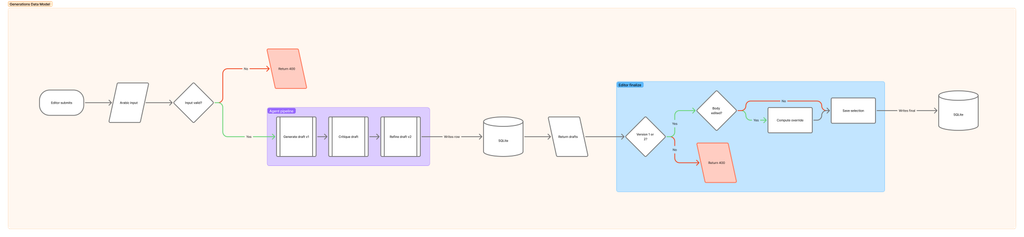
I built a 3-agent agentic pipeline where AI critiques and refines its own work before presenting options to the editor.
The Pipeline
Input: "ارتفاع أسعار النفط"
         ↓
🤖 AGENT 1: GENERATOR
   Creates Draft V1: 3 headline options, body, SEO, tags
         ↓
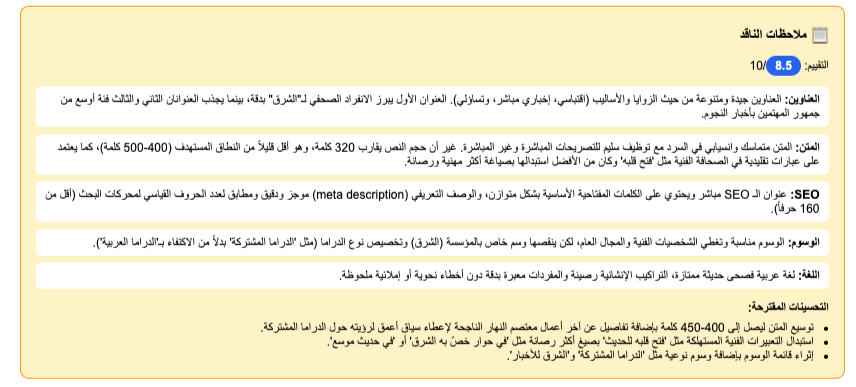
🔍 AGENT 2: CRITIC
   Reviews V1 section-by-section in Arabic
   Scores each section, flags issues
         ↓
✨ AGENT 3: REFINER
   Takes V1 + critique → produces improved Draft V2
         ↓
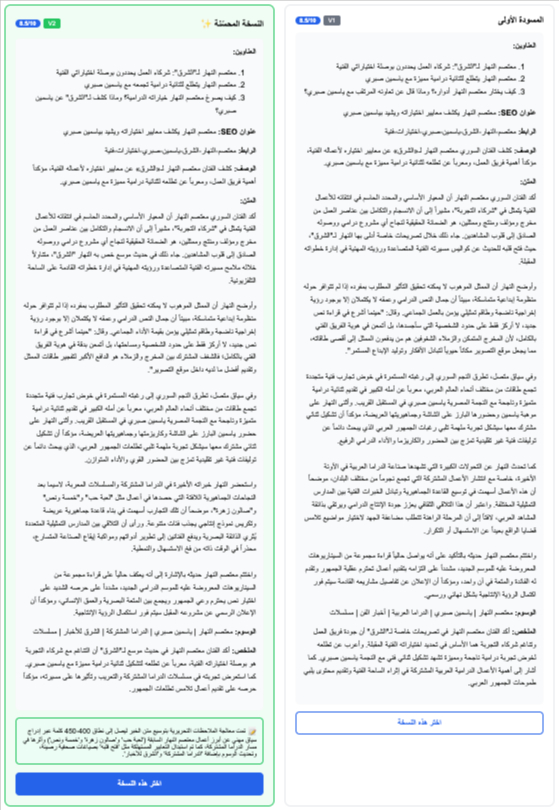
📊 EDITOR VIEW
   Side-by-side comparison: V1 vs V2
   Editor picks, edits, or overrides
         ↓
💾 AUDIT LOG
   Tracks: which version selected, what was edited, override %
Key Features
- Two Generation Modes
- Simple Mode
- Agentic Mode
- Arabic – First Design
- Right-to-left interface
- Arabic prompts and critique feedback
- Designed for Gulf newsroom standards
- Human-in-the-loop Governance
- Editor always has final say
- Override tracking: system logs when editors change AI output
- Override percentage calculated and stored
Full Audit Trail
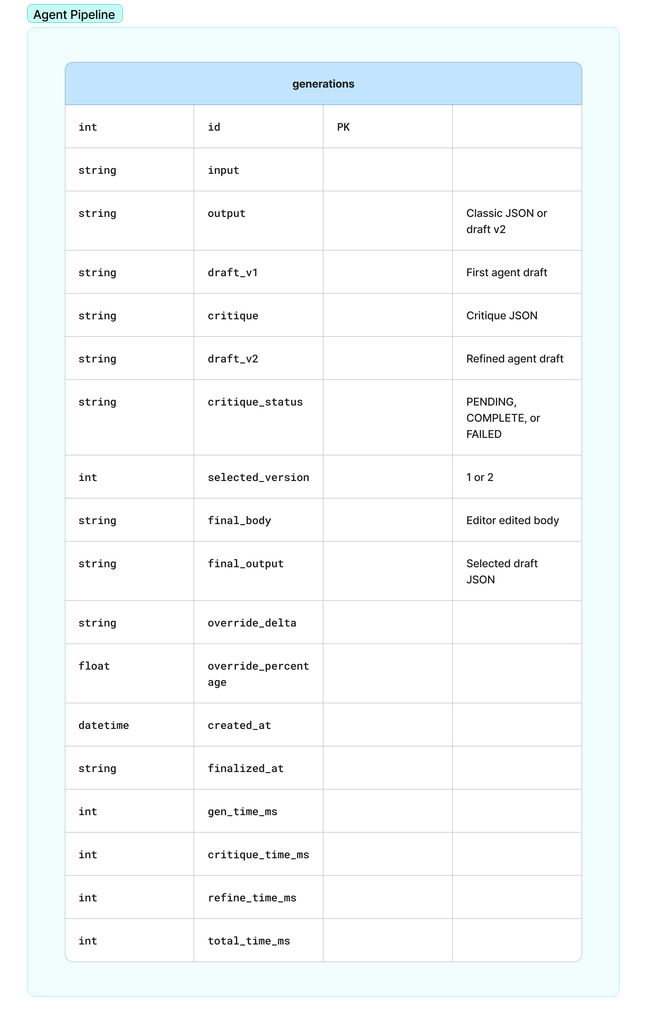
Every generation stores:
- Original Input
- Draft V1 (Generator output)
- Critique (Critic feedback with scores)
- Draft V2 (Refiner output)
- Selected version (1 or 2)
- Editor’s final body (if edited)
- Override delta and percentage
- Timing Metrics (gen_time_ms, critique_time_ms, refine_time_ms)
Archietecture
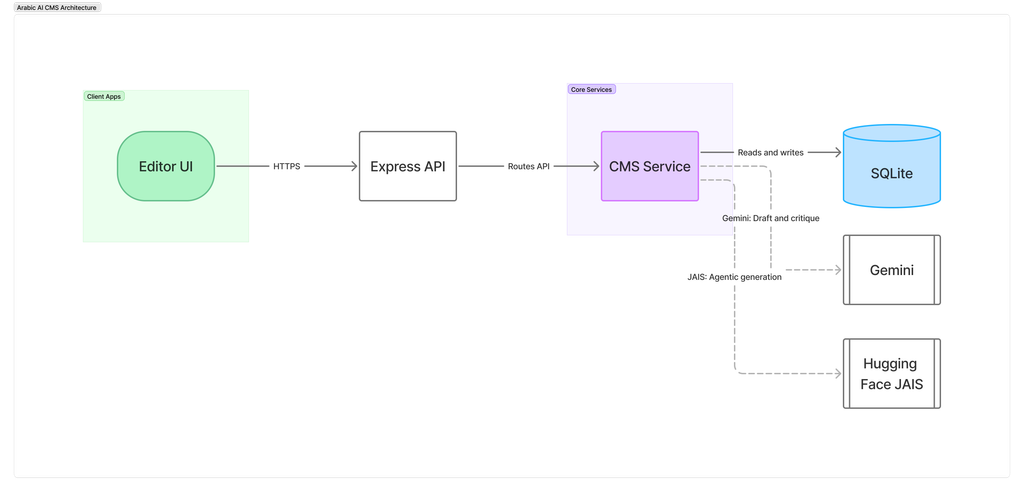
Evaluation Framework
AI Output is unpredictable. Every generation could fail silently. Editors catching mistakes is expensive.
I built a 20 case eval suite that validates LLM ouput against the same rules the production system enforces.
The Eval Set
| Check | Test Cases |
|---|---|
| Headlines | 5 |
| Tags | 5 |
| Body Lenght | 5 |
| Slug | 5 |
| SEO description | 5 |
Each case is a real editorial – style Arabic topic like:
Structural Checks
| Rule | Validation |
|---|---|
| Headlines | Exactly 3 |
| Tags | Exactly 5 |
| Body Length | 350-650 words |
| Slug | Arabic-only with hyphens |
| SEO description | <160 characters |
Running Evals
node server/evals/run-evals.js http://localhost:5001Output:
[PASS] #1 (Politics) score=8/10
[PASS] #2 (Politics) score=7/10
[FAIL] #3 (Politics)
        - body word count 312 outside [350, 650]
...
18/20 passed (90.0%)
Exit code 0 = all pass. Integrates with CI.
Why This Matters
Most AI writing tools ship without evaluation. When output fails, editors catch it – or worse, readers do.
This eval framework:
- Catches structural failures before they reach the editor
- Enables CI/CD – blocks deploys if evals regress
- Documents Quality – 90% pass rate is auditable proof the system works
Tech Stack:
- Frontend: Vanilla JS, Tailwind CSS
- Backend: Node.js, Express
- Database: SQLite
- AI: Google Gemini 2.5 Flash (architected to swap to Jais Arabic LLM)
Why this Matters for Saudi Newsrooms:
| Challenge | How this Solves it |
|---|---|
| AI makes grammar errors | Critic agent catches issues before editor sees them |
| No visibility into AI decisions | Full audit trail for every generation |
| Editors waste time fixing AI | V2 is already improved; editor reviews, not rewrites |
| Compliance concerns | Override tracking proves human oversight |
Screenshots:
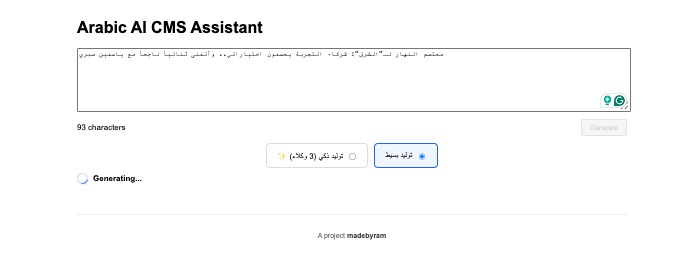
➡️ Mode Toggle
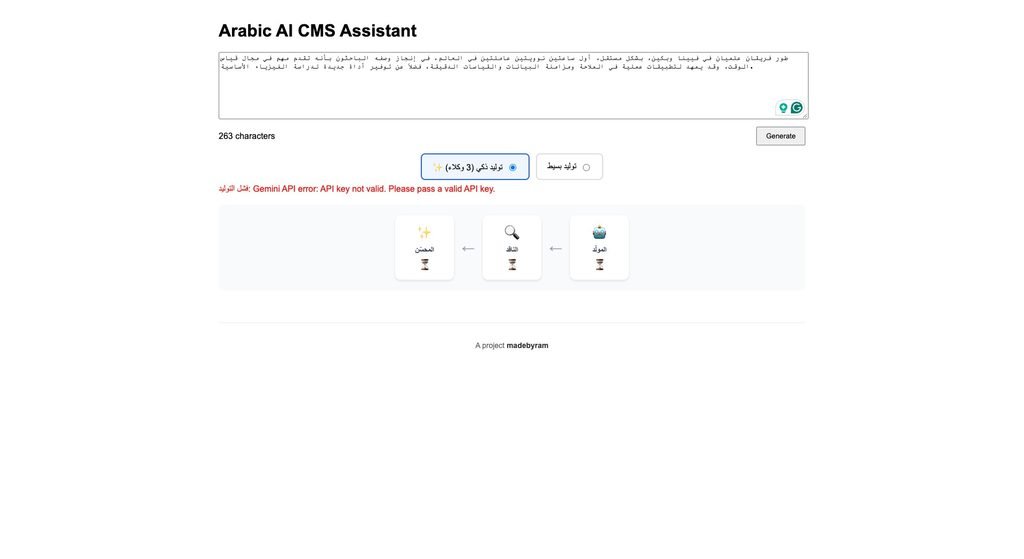
➡️ Agent Progress
➡️ Critique Panel
➡️ Side – by – Side Comparison
➡️ Demo Video
What I learned
- Agentic loops need structure – Without clear handoffs between agents, output degrades
- Arabic critique is harder – The critic prompt required careful tuning for proper Arabic Feedback
- Audit trails build trust – Editors adopted faster when they could see exactly what the AI changed
Links
Built With
- Node.js + Express
- SQLite
- Google Gemini 2.5 Flash
- Vanilla JS + Tailwind CSS
- Figma (architecture diagrams)
Part of myAI PM portfolio demonstrating agentic AI patterns for enterprise content workflows.