 December, 2025
 “Vibe coding is the new product management” is a line that spreads quickly becuase it points at something real. The distance between an idea and a working prototype has collapsed. A single person can now explore product directions in hours that used to take a team and a sprint.
That shift matters. It changes how teams learn, how they hesitate, and what an early-stage product looks like.
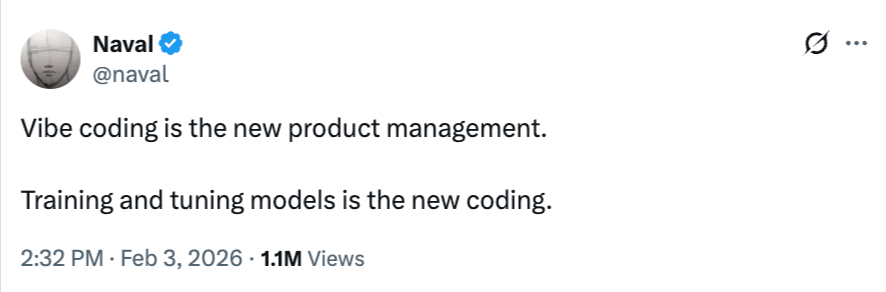
But vibe coding is not product management. It is closer to what prototyping has always been: a way to reduce uncertainty. It helps answer questions faster, but it does not tell you which questions are worth asking.
What Vibe Coding Makes Easier
The most obvious change is speed. The “Build” step has become cheaper.
A product person can now create something small and real, quickly enough to learn from it:
- a rough onboarding flow
- a lightweight internal tool
- a new dashboard layout
- a prototype to test an assumption
- a small automation that removes repetitive work
This is valuable becuase it shifts product conversations away from speculation. Instead of debating an idea for weeks, you can often put something in front of users and see what happens.
The Prototypes was never the hard part
The hard part of product work has always been upstream.
Before anything is built, someone still has to decide:
- what problem deserve attention
- which costomer pain matters most right now
- what trade-offs is the team making
- what is being ignored on purpose
- what success actually looks like
These are not coding questions, and they are judgment questions.
AI can generate interfaces, flows, and even working code, but it cannot supply taste, context, or the human work of choosing what matters.
Customers are still human
AI is good at producing support.
But it’s not good at caring.
Most products don’t succeed becuase they were built quickly; they succeed becuase someone understood people well. Customers act based on trust, fear, habit, motivation and emotion. Those forces are still present, no matter how advanced the tools become.
Speed helps, but speed alone does not create good products. Many teams can build quickly, and fewer teams can build the right thing.
The Role is Moving Closer to Building
What is changing is that product people are being pulled closer to execution. Not becuase every PM needs to become an engineer, but becuase experimentation is now cheaper and faster. The feedback loop is shorter. The product conversation can start with something real instead of something imagined.
In this world, the advantage is not simply shipping a demo.
The advantage is knowing what the demo is trying to prove.
An accelerator, not a replacement
Vibe coding is useful. It helps teams explore faster.
But product management is still the job of understanding people, making decisions under uncertainty and carrying responsibility for outcomes.
The tools have changed.
The craft has not.